Deep space optical communication is an efficient alternative to radio frequency (RF) technology, offering higher data bandwidth. The challenge lies in the fact that deep space optical communication is limited by photons. Eliminating stray light is crucial for maximizing signal quality. Ultra-narrow bandpass filters with high optical density (OD) can meet this requirement while increasing signal throughput.
This article presents the design trade-offs and fabrication results of ultra-narrow bandpass filters with a bandwidth of 0.2 nm full width at half maximum (FWHM), in-band transmittance greater than 95%, and out-of-band rejection greater than OD 5. These filters are designed to match laser wavelengths in the 1550 nm region.
1.0 Introduction
Optical communication offers the potential for data bandwidth up to 40 times higher than radio frequency technologies, while significantly reducing the weight and power consumption of flight terminal stations. A key requirement for deep-space optical communication links is the efficient suppression of stray and ambient light while maintaining high in-band transmittance. Ultra-narrow bandpass interferometer filters with bandwidths less than 0.2 nanometers can provide this capability. The challenge in fabricating ultra-narrow bandpass filters lies in the need to precisely tune the passband wavelength to cover the entire aperture of the filter. The method proposed in this paper for achieving high uniformity is laser-targeted annealing.
We offer custom coating services (UV (13.5nm Mo/Si plane mirror (63% reflectivity), 193nm, 266nm, 355nm, 405nm plane mirrors and antireflection coatings), visible light (two, three, four channel filters, 1nm half-height filters), near-infrared, metal reflective coatings (gold, silver, copper, aluminum), narrowband (near-infrared bandwidth 0.3nm, visible light bandwidth 1nm)), mid- and far-infrared (antireflection coatings, filters). We also have a large inventory of standard filters; please contact me for an inventory list.
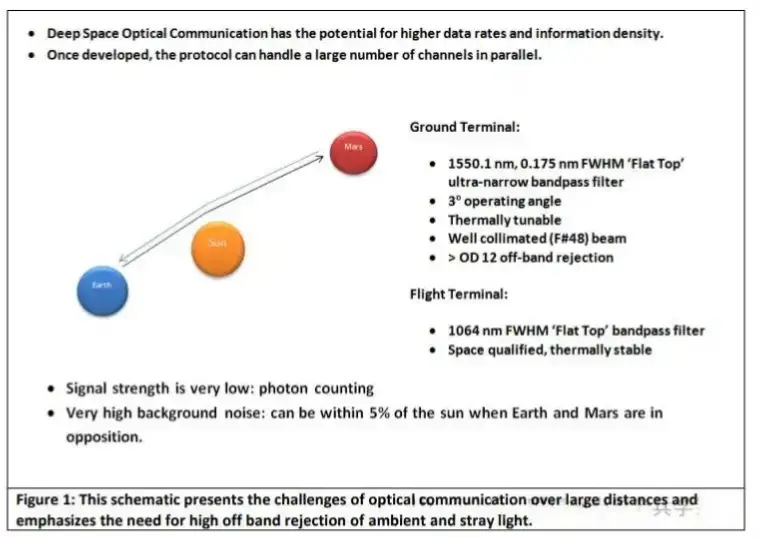
Optical filters are crucial for maximizing the signal-to-noise ratio (SNR) between ground stations and satellites or probes in deep space. The objective mission is optical communication between the ground station and Mars orbiters and probes. Optical interferometer filters must allow weak laser light to pass through while suppressing ambient sunlight and background starlight. The most challenging requirement for the filters is maintaining a sufficient SNR when Earth and Mars are in opposition and the communication path is at an angle of less than 5 degrees to the sun. Figure 1 illustrates the mission challenges.
2.0 Filter Design
The basic design of an optical interference bandpass filter is the Fabry-Perot design. This design consists of a pair of mirrors separated by an optical cavity. The optical thickness of the cavity layer causes the reflections from each mirror to become incoherent with each other, thus determining the center passband wavelength. This design is relatively insensitive to thickness errors in the films that make up the mirror stack, but is very sensitive to errors in the cavity layer and its adjacent layers. For a single-cavity Fabry-Perot filter, errors in the cavity layer shift the center passband wavelength but do not significantly reduce the passband shape or peak transmittance.
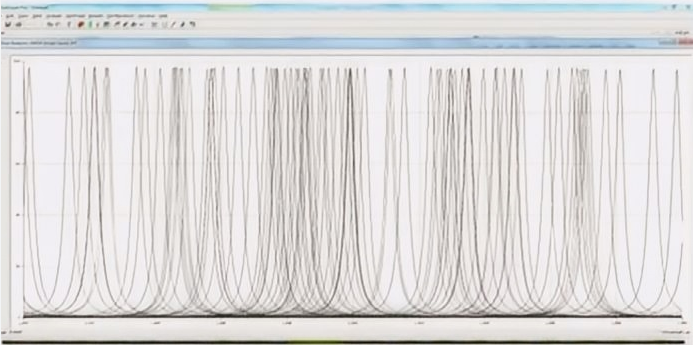
Figures 2 illustrate these sensitivities. Figure 2 shows the simulated transmittance of a single-cavity passband design using Monte Carlo simulation of random layer thickness errors.
The fabrication of commercially viable “flat-top” multi-cavity bandpass filters with bandwidths of 1 nanometer and greater and wavelengths of 1550 nanometers has been well-proven and is within the capabilities of high-precision commercial optical coating and metrology equipment.
ABOUT BORISUN
Hanzhong Brisun Optics Co., Ltd. Is the high precision optical element manufacturer provides customized production of Various optical lenses, including spherical lens, cylindrical lens, optical window, mirror, prism, filter, metal base mirror and other high-precision optical elements. The base materials include various optical glass, fused quartz, calcium fluoride (CaF2), zinc selenide (ZnSe), germanium (GE), silicon (SI), sapphire, metal and other materials. And provide antireflective film, high reflection film, spectroscopic film, metal film and other optical coatings.