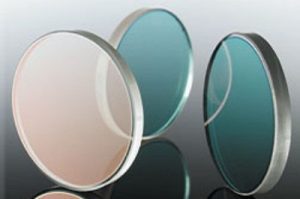
Reflective Ultra-Narrow Bandwidth Filter (FWHM down to 20pm) –Ultra-Narrow Bandwidth, Spatial Light
Currently, narrowband filters on the market are generally 10nm, with even the narrowest reaching only around 0.5-1nm.
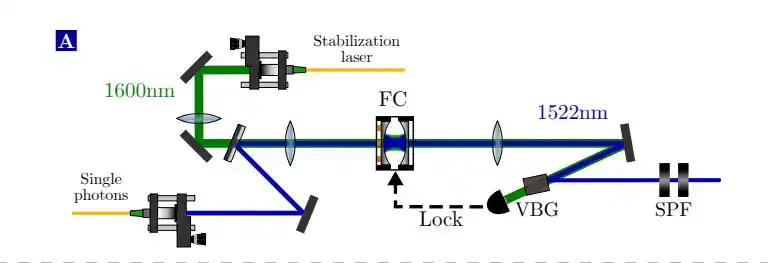
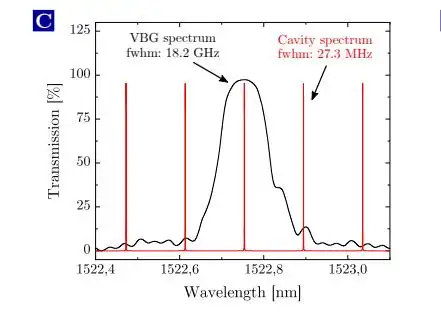
The reflective ultra-narrow bandwidth filter is an ultra-narrow bandwidth filter product (FWHM down to 20pm). It is a filter product based on the principle of volume Bragg grating (VBG), which not only provides an ultra-narrow bandwidth but also achieves high diffraction efficiency (up to 95%) and polarization independence, with stable physical properties. It is an ideal choice for narrow bandwidth filtering applications in spatial light and has already been applied in quantum optics, terahertz spectroscopy, ultrafast spectroscopy, and narrow linewidth lasers.

Volume Bragg grating (VBG) technology was developed at the University of Florida’s Center for Research and Education in Optics and Lasers (CREOL).
This technology utilizes ultraviolet radiation to thermally process inorganic photosensitive glass (PTR). By applying various special doping elements to the interior of the photosensitive glass, the refractive index is permanently altered. Through this holographic exposure method, a diffractive volume Bragg grating (VBG) with phase modulation capability is achieved. VBGs can be categorized into the following main products based on specific applications:
Volume Bragg Grating Mirrors (RBG) – Wavelength locking, linewidth narrowing;
Chired Volume Bragg Gratings (CVBG) – Pulse broadening and compression at fs/ps;
Ultra-narrow band filters (BPF) – Ultra-narrow linewidth filtering;
Notch filters (BNF) – Ultra-low wavenumber Raman measurements and Thomson scattering;
Transmission Bragg Gratings (TBG) – Angular magnification;
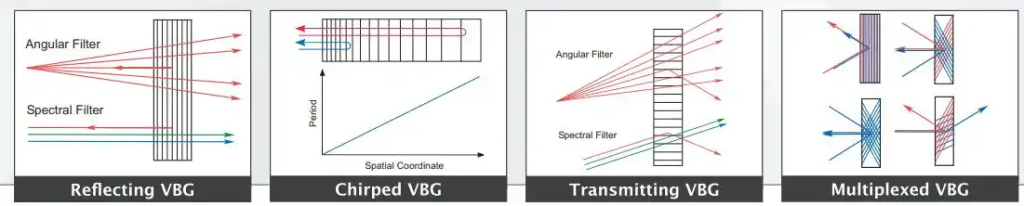
Key Product Features:
1. Ultra-narrow bandwidth (FWHM as low as 20pm);
2. High diffraction efficiency (up to 95%);
3. Polarization uncorrelated;
4. Stable physical properties, not prone to deliquescence;
5. Customizable parameters (wavelength, bandwidth, size, coating, etc.);
VBG Key Parameters:
1. Wavelength Range: 350-3000nm;
2. Diffraction Efficiency: 10%-99%;
3. Full-Way Multimeter (FWHM): 20pm – 2nm;
4. High Damage Threshold Coating (Optional)
For example, wavelengths include: 405nm, 530nm, 630nm, 780nm, 795nm, 800nm, 810nm, 813nm, 863nm, 895nm, 1030nm, 1064nm, 1341nm, 1522nm, 2200nm, etc.
Example Display: