Off-axis parabolic mirrors (OAPs) are widely used in high-field laser physics. Light after a femtosecond laser pulse compressor is typically focused onto a target using an OAP, achieving terawatt or petawatt-level focused power. This is primarily because ultrashort, ultra-intense lasers are collimated during amplification and remain collimated after exiting the compressor grating. To achieve perfect focusing at a single point, a paraboloid is necessary, as it can perfectly focus parallel light to a single point. Off-axis mirrors prevent plasma sputtering onto the compressor grating during experiments, and they also prevent the use of lenses (as the dispersion introduced after the compressor cannot be compensated). Even when using a mirror, it must be off-axis.
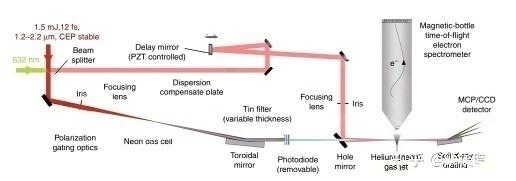
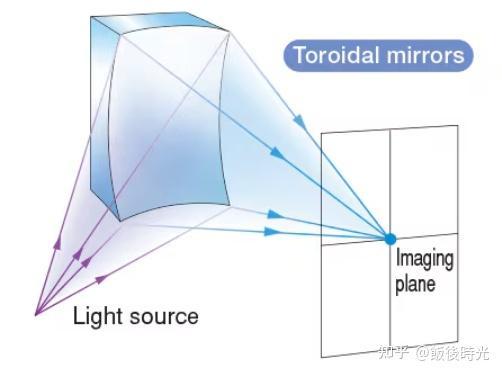
The choice of mirror depends mainly on the characteristics of the light to be focused. For example, focusing a point source onto a target requires a toroidal mirror. The light path diagram below, generated by an isolated attosecond pulse, illustrates point-to-point focusing.
That’s roughly the effect; I guess it’s just taking a portion of the ellipsoid.
Let’s return to the question of how to adjust OAP.
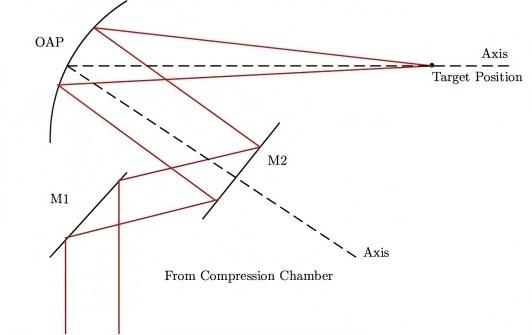
Adjusting the OAP involves two steps: (1) First, adjust the OAP to focus the laser onto the target point; (2) Adjust the incident angle to make it parallel to the optical axis. Then, iterate repeatedly until it’s properly adjusted (the second step will cause the focusing position to deviate, so after adjustment, the first step needs to be performed again; it will eventually converge). As for why OAP is adjusted before the optical axis, it’s simply a matter of practice…
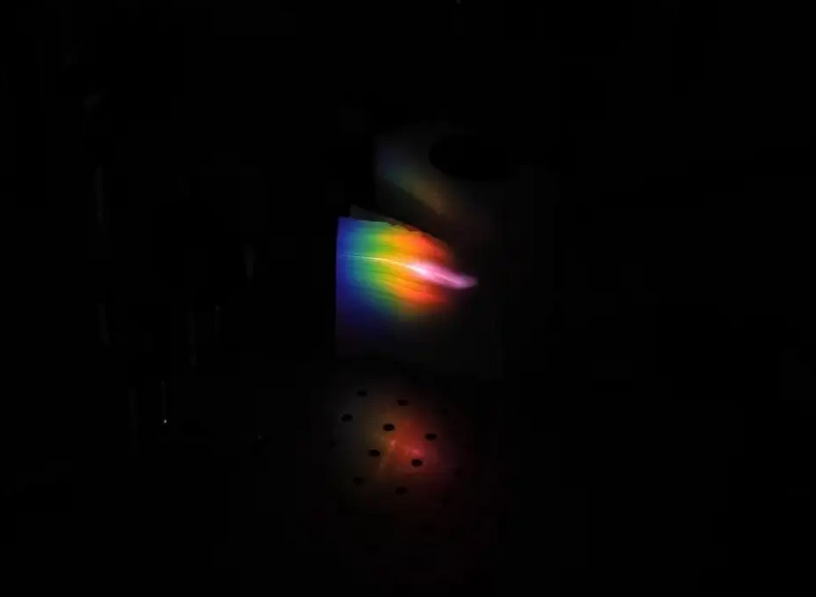
Of course, to achieve the optimal position, the location of each mirror needs to be planned during the optical path setup. For example, if the OAP (Optical Angle Point) is 30 degrees off-axis, then reflectors M1 and M2 need to be placed in advance so that the incident light is incident at an angle of approximately 30 degrees. A bench mark is needed during the adjustment process. In low light, the ND and CCD can be viewed directly; in strong light, filaments can be seen. Filaments are the beautiful things shown below.
Because parabolic mirrors, compared to spherical mirrors, introduce more coma and astigmatism due to off-axis focusing, it’s very noticeable whether the focusing is correct during the adjustment process. For example, in filamentation, if the incident light is not parallel to the optical axis, the filament (1) will not be a circle (2) and the intensity will be uneven from side to side, resulting in weak brightness. The same principle applies to CCDs.
ABOUT BORISUN
Hanzhong Brisun Optics Co., Ltd. Is the high precision optical element manufacturer provides customized production of Various optical lenses, including spherical lens, cylindrical lens, optical window, mirror, prism, filter, metal base mirror and other high-precision optical elements. The base materials include various optical glass, fused quartz, calcium fluoride (CaF2), zinc selenide (ZnSe), germanium (GE), silicon (SI), sapphire, metal and other materials. And provide antireflective film, high reflection film, spectroscopic film, metal film and other optical coatings.