PRODUCT CATEGORIES
INOUIRY
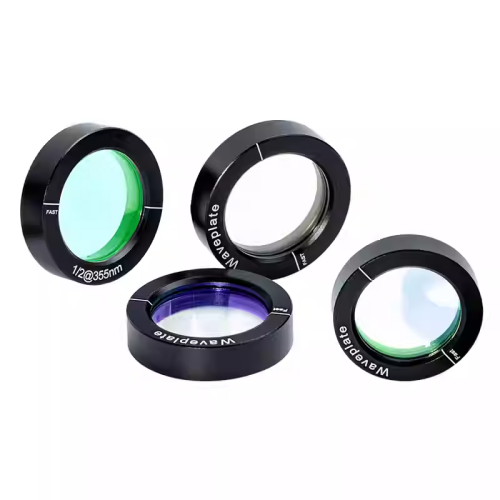
Wave plate, also called a phase retardation plate, is an optical element that alters the polarization state of light by creating an optical path difference (or phase difference) between two orthogonal polarization components. The incident light exits differently depending on the type of waveplate, resulting in linearly polarized, elliptically polarized, or circularly polarized light, among others.
Waveplates are primarily made of birefringent crystals such as quartz, mica, and calcite.
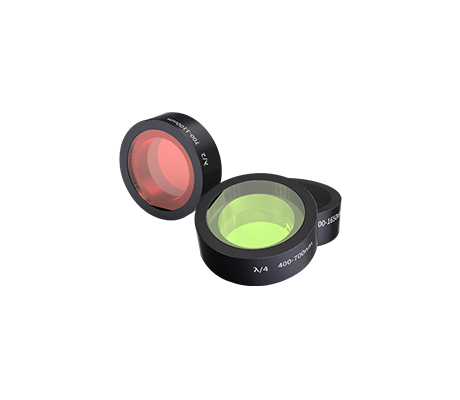
Borisun Optics can provide cemented zero-order 1/2-waveplates, cemented zero-order 1/4-waveplates, multi-order 1/2-waveplates, and multi-order 1/4-waveplates.
Cemented zero-order waveplate (Compound Zero-Order Waveplate), also called a composite waveplate, is made by cementing two multi-order waveplates together. Aligning the fast axis of one waveplate with the slow axis of the other eliminates the full-wavelength optical path difference while retaining the desired optical path difference.Cemented zero-order waveplates improve the effect of temperature on the waveplate, but also increase the sensitivity of the waveplate’s retardation to the incident angle and wavelength.
The thickness of a multiple-order waveplate is equal to the sum of the thicknesses of multiple full waves and the required delay thickness. Multiple-order waveplates are easy to manufacture, but they are very sensitive to wavelength, temperature, and angle of incidence.