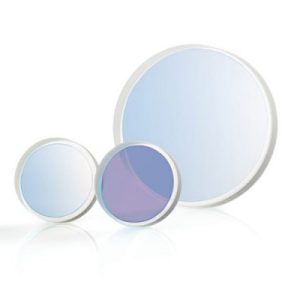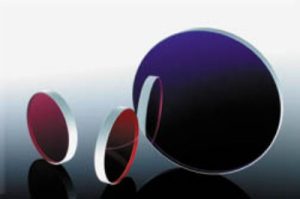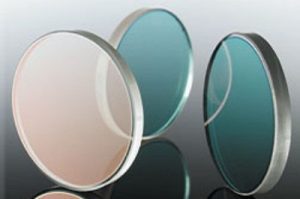
Face recognition technology identifies information related to a person’s facial features, and it is a type of biometric technology.
Using an image acquisition device to capture images or video streams containing human faces, and automatically detecting and tracking faces based on the images, as well as locating and extracting facial features, the purpose of face recognition is to identify different individuals through comparison and recognition. The computation required for face recognition is immense, and the quality of the initial image and the superiority of the algorithm have a decisive impact on recognition efficiency. Here, we primarily analyze the narrowband filters used in the image acquisition device of the face recognition system, aiming to help users better understand the role and usage of narrowband filters, so as to correctly select the technical specifications of narrowband filters.
Due to the large computational workload of face recognition, it is currently conducted based on black-and-white grayscale images
The schematic diagram of its image acquisition structure is shown in Figure 1:
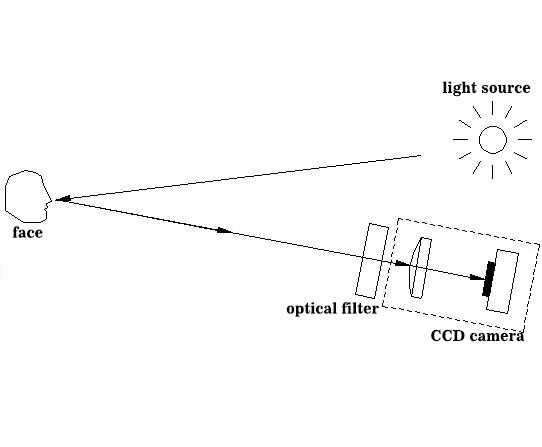
In the image acquisition device for face recognition, the light source generally employs high-power infrared diodes, with wavelengths mostly being 850nm and 940nm. To enhance recognition efficiency and improve light utilization, the overall design must be considered from the selection of the light source. Although commercially available LEDs have nominal values of 850nm or 940nm, there are still significant deviations when measuring the center wavelength of specific LED products. Taking an 850nm LED as an example, its actual center wavelength can range from 835nm to 865nm. Since the light source used in the face recognition system consists of multiple high-power LED arrays, if the center wavelengths of individual LEDs are not consistent, the spectral bandwidth of all LEDs will widen after being superimposed. The bandwidth of a single 850nm LED is around 50nm, but if the center wavelengths are not consistent, the spectral bandwidth of multiple LEDs after superimposition will become very wide. This is detrimental to the subsequent selection of narrowband filter bandwidth, energy utilization, and signal-to-noise ratio improvement. Therefore, it is required that the center wavelengths of LED light sources be consistent. Additionally, as the operating temperature of the LED light source increases, its center wavelength drifts towards longer wavelengths, with a drift of about 1nm per 10℃ increase in temperature. Furthermore, as the operating temperature increases, the luminous efficiency of the LED rapidly decreases, and when it reaches around 85℃, the output efficiency of the LED drops to about 50%. Therefore, good heat dissipation is required for the LED light source. Additionally, when selecting the divergence angle of the LED emitter, a smaller divergence angle is preferred, as this can improve the energy utilization efficiency of the light source.
Receiver Characteristics
In face recognition systems, the receiver primarily employs a CCD image sensor. CCDs are widely used in various image acquisition systems due to their advantages, including small size, light weight, low distortion, low power consumption, low-voltage drive capability, shock resistance, vibration resistance, and strong electromagnetic interference resistance. The CCDs used in face recognition systems are primarily silicon-based, with a spectral response range of 400nm to 1100nm, which is also the spectral range that narrowband filters need to consider.
Narrowband filters are primarily used to isolate interference light, transmit signal light, fully highlight useful information, reduce interference information, and lay the foundation for subsequent image processing and recognition. Currently, face recognition is mainly applied in attendance and access control systems in various settings. Some are installed in indoor areas with dim lighting, while others are installed in brighter areas. The intensity of interference light varies in different settings, thus the requirements for narrowband filters also differ.
We have found that people often use infrared glass that blocks visible light and transmits infrared light as an interference light isolation filter, which can certainly achieve certain effects. However, ordinary infrared glass only blocks visible and ultraviolet light, but not infrared light. In actual interference light, all wavelengths from visible to infrared are present, because the spectrum of sunlight is very wide, and diffusely reflected or scattered sunlight is the main source of interference. Therefore, to achieve good anti-interference effects, narrowband filters must be used. Narrowband filters are very effective in blocking all interference light outside the signal spectral range.