Raman Detection Filters
Raman spectroscopy analysis is an important material analysis and testing technique that can qualitatively and quantitatively analyze substances, and is a fingerprint spectrum of the molecular structure of substances. It utilizes the Stokes and anti Stokes effects of matter and is typically used in conjunction with a filter and laser.
Raman filters are generally divided into laser bandpass filters, sharp cut long wave pass (short wave pass) filters, and negative filters.
Core parameters of four categories of Raman specific filter bands
1. Edge Filters (RazorEdge long/short wave pass)
(1) Long wave pass Edge (BLP, Stokes measurement, 90% conventional Raman system)
Band rules: Cut off edge=laser wavelength+1~3nm, laser full cut off, long wave Raman full transmission
Standard excitation band spot series:
UV:212/266/325/355/405 nm
Vis:488/514.5/532/561/633 nm
NIR:785/808/980/1064 nm
Key indicators of the frequency band:
1. Transition steepness (OD6 → wavelength width of 50% transmission): The high-end NanoEdge is only 1nm (corresponding to low wave number detection of 30-40 cm ⁻¹); Ordinary Edge 3-5nm (measured from 100-200 cm ⁻¹)
2. Transmitting band: cutoff edge~1200/1600nm, average transmittance>90%
3. Cut off depth: Laser line OD6~OD8 (suppressing 10 ⁶~10 ⁸ times elastic scattering laser)
(2) Short wave pass Edge (SP, only measuring anti Stokes)
Band rule: Cut off edge=laser wavelength -1~3nm, short wavelength anti Stokes transmission, laser cut-off
Applicable: Simultaneous measurement of Stokes+anti Stokes bispectrum and CARS coherent Raman spectroscopy
Example 532nm short wave pass: passband 200-531nm, stopband 532-1200nm, minimum detectable 186cm ⁻¹ anti Stokes
2. Notch Notch Filters (StopLine, simultaneous measurement of Stokes and anti Stokes)
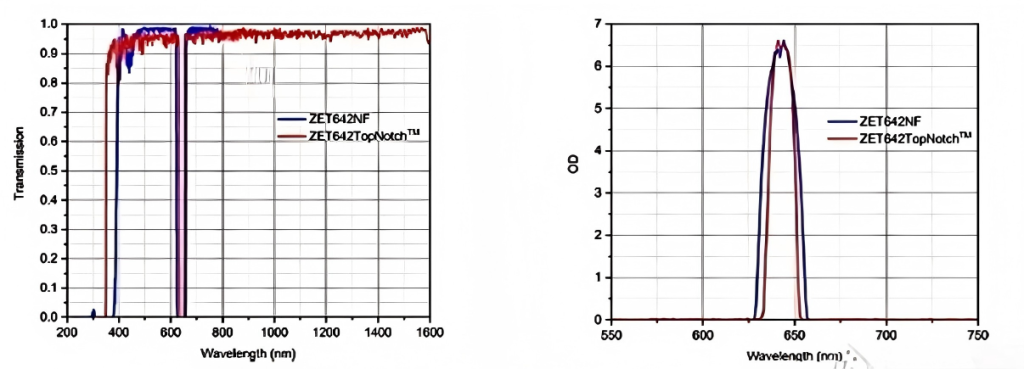
Band structure: Full width passband+narrow central stopband, precise stopband coverage of laser wavelength, and both long and short Boraman signals pass through on both sides
Standard stopband band parameters:
The stopband bandwidth FWHM is 8-22nm (widening with increasing laser wavelength), such as 212nm Notch stopband ≈ 8nm, 532nm ≈ 17nm, 1064nm ≈ 25nm
Cut off depth of stopband: OD6~OD7 (laser suppression by more than 10 times)
Bilateral passband: Short wave passband 200~λ ₀ -5nm, long wave passband λ ₀+5~1600nm
Advantages and disadvantages: It can simultaneously collect high and low wavenumbers, Stokes/anti Stokes; Low wavenumber lower limit obstructed band bandwidth limitation, can only measure 80-200 cm ⁻¹, inferior to narrow Edge filters
3. Laser Line Narrowband Bandpass Filters (LL02, excitation path purification laser)
Band function: Filter laser stray light, ASE fluorescence, and output monochromatic pure excitation light
Band parameters:
Center wavelength CWL: matched excitation laser 212/355/532/785/1064nm
FWHM bandwidth: 2-7nm (UV 212nm is usually a narrowband of 2-3nm)
Out of band cutoff: OD5~OD6, transmittance UV>55%, VIS/NIR>90%
Supporting logic: After exciting the laser source in the optical path, it must be added to ensure that only a single wavelength laser is incident on the sample
4. Dichroic (Optical Path Splitting Core)
Band function: Reflecting excitation laser to sample, transmitting Raman scattering signal to spectrometer
Band boundary: Reflection band<laser wavelength+2nm, transmission band>laser wavelength+3nm
212nm dichroic mirror: Reflecting 200-214nm (>99% reflection), Transmitting 215-700nm (T>90%)
The cut-off steepness (wavelength interval from 50% transmission position to OD6 cut-off depth) is a key indicator for measuring the performance of Raman filters, and Borisun Optics can provide Raman filters with a cut-off steepness of up to 1% or less.
The cut-off steepness (wavelength interval from 50% transmission position to OD6 cut-off depth) is a key indicator for measuring the performance of Raman filters, and Borisun Optics can provide Raman filters with a cut-off steepness of up to 1% or less.
There are some stock models available for selection above, if you need custom Optical Raman filter or bulk orders, please contact our sales team:
info@borisuns.com
Related Products