Glycated Hemoglobin Analysis Filters
The use of ion exchange high-pressure liquid chromatography (HPLC) to determine the percentage content of HbA1c is currently considered the gold standard for analyzing HbA1c.
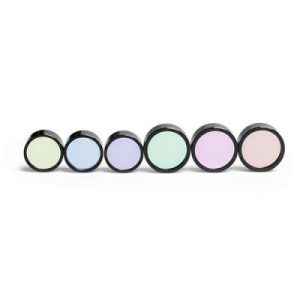
Glycosylated hemoglobin instruments have three mainstream detection principles, corresponding to completely two wavelength schemes, and the filter cannot be used interchangeably; All belong to the narrow band bandpass BP filter of transmittance colorimetry, with a specification system similar to that of biochemical filters, but there are significant differences in wavelength combination and general biochemical analyzer.
Standard size: Φ 8/Φ 10mm, universal thickness for mass production 2.0 mm.
Three major detection schemes&standard wavelength combinations
Scheme 1 | Latex enhanced immune turbidity method (fully automated biochemical matching, desktop HbA1c equipment)
Principle: Agglomeration turbidity detection, dual wavelength deduction of sample turbidity and bubble interference
Main wavelength: 660 nm (core measurement channel)
Reference wavelength: 800 nm (infrared reference channel)
Industry standard configuration: BP660+BP800
Optical standard parameters:
FWHM = 8~10 nm; CWL tolerance ± 2 nm; peak transmittance Tp ≥ 78%; Cut off OD ≥ 4-5; Substrate: B270/D263T
Scheme 2 | Boric Acid Affinity/HPLC Ion Exchange Chromatography (Independent Saccharification Analyzer)
Directly detect the absorption peak of hemoglobin itself (Soret absorption band)
Core wavelength: 415 nm (mainstream), some models have 420 nm; some models are equipped with 500 nm dual wavelength calibration
Equipment examples: Arkray Aikolai HA series, various chromatography POCT saccharification machines
Parameters: FWHM 8~10nm; Base B270
Scheme 3 | Fluorescence quenching method (small portable POCT saccharification equipment)
Belonging to the fluorescence filtering system, used in pairs:
Excitation channel Ex510 nm; The emission channel is Em580 nm, with a commonly used bandwidth of 10-15 nm.
Two Mainstream Complete Sets of Filters
Group A | Immunoturbidimetric type (universal biochemical module, desktop HbA1c)
BP660 nm (main measurement), BP800 nm (reference)
Group B | Chromatography/HPLC ion exchange saccharification analyzer
BP415 nm (single wavelength)/BP420+BP500 (dual wavelength version)
The above models are available in stock for you to choose from, if you need custom Optical Glycosylated hemoglobin analysis filters or bulk orders, please contact our sales team:
info@borisuns.com
Related Products