Flow Cytometry Analysis Filters
Flow filter is the core optical component for instrument spectral separation and differentiation of fluorescence signals. Its function is to separate excitation laser, scattered light, and different fluorescence emission light, and send the corresponding band signals to the photomultiplier tube (PMT) to determine the signal-to-noise ratio and color mixing degree of multi-color experiments.
Four core filter elements (optical path division)
1. Dichroic Mirror (dichroic mirror, placed at 45 °)
1. Dichroic Mirror (dichroic mirror, placed at 45 °)
The core of streaming multi-channel splitting, which combines reflection and transmission, is divided into long pass bidirectional DLP and short pass bidirectional DSP according to the cutoff wavelength:
DLP500: Transmitting light>500nm and reflecting light<500nm;
DSP575: Transmittes light<575nm and reflects light>575nm;
Purpose: Gradually split mixed fluorescence and guide different bands to independent detectors; Multi laser systems are also used for laser beam combining.
Key indicators: high flatness, low wavelength drift, cut-off depth OD ≥ 5.
2. Bandpass filter BP Bandpass (emission detection chip, standard before PMT), the most commonly used flow filter
Function: Accurately capture a single fluorescence emission peak, block laser stray light, and prevent adjacent fluorescence from crossing colors;
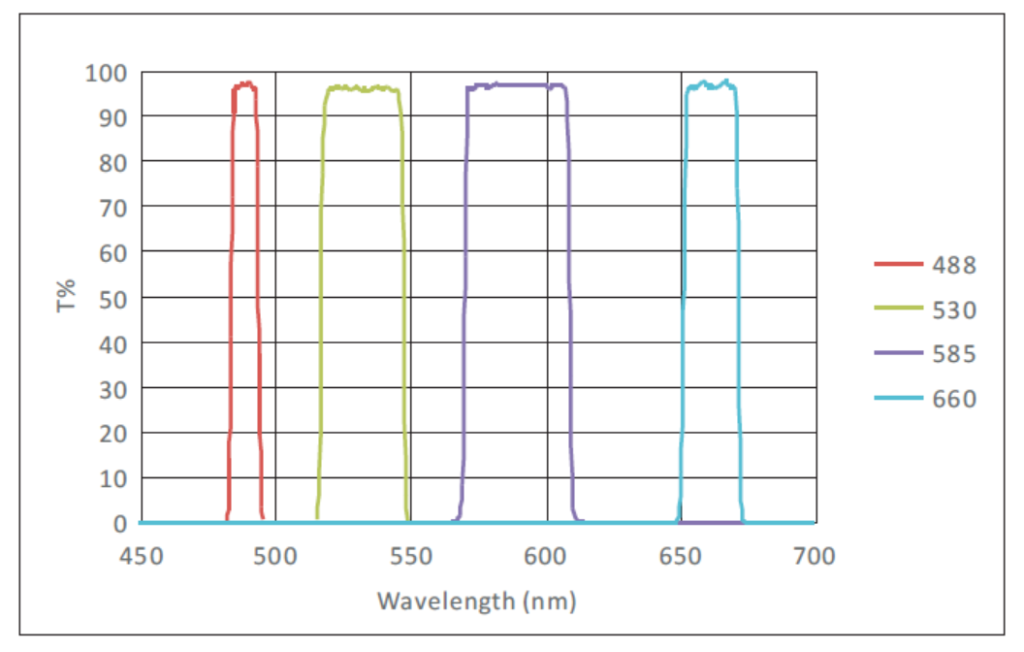
Narrowband (10-30nm): multi-color experiment, reduced compensation; Broadband (40-60nm): weak fluorescence, increased signal intensity;
Performance threshold: passband transmittance>92%, laser band cut-off depth OD6 (blocking 99.9999% stray light).
3. Long wave pass filter LP Longpass
Only pass through all light above the cutoff wavelength, mark 550LP (only pass above 550nm)
Used in conjunction with BP: First LP coarse band segmentation, then BP fine segmentation;
Scenario: PE, PE-Cy5, APC red light channel pre coarse filtering.
4. Short wave pass filter SP Shortpass
Only transmit light below the cutoff wavelength, mark 495SP (only below 495nm)
Scenario: UV/UV laser (405nm) fluorescence, separation of short wavelength blue fluorescence.
Mainstream laser matching standard filter configuration (laboratory universal)
1. 488nm blue laser (most commonly used, argon ion)
Fluorescein emission peak standard BP filter front dichroic mirror
FITC、Alexa488 519nm 525/30 BP DLP500
PE、Alexa546 575nm 575/25 BP DLP550
PerCP、PE-Cy5 670nm 670/30 BP DLP640
2. 405nm Purple Laser
BV421/ Pacific Blue:450/50 BP
BV510:510/20 BP
3. 633/640nm red laser
APC、Alexa647:660/20 BP
APC-Cy7:780/60 BP
Key Optical Parameters (selection core)
1. Center wavelength CWL: matches the fluorescence emission peak, and a shift greater than 5nm will significantly reduce the signal;
2. Full Width at Half Maximum (FWHM): The smaller the bandwidth, the less color distortion, but the lower the luminous flux; Multi color should be ≤ 30nm as much as possible;
3. Cut off depth OD value
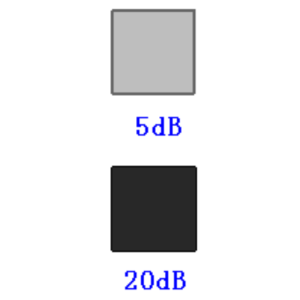
OD3: Blocking 99.9%; OD6: Block 99.9999%; The streaming emitter must have OD5-OD6 to completely block the excitation laser;
4. Incident angle: 45 ° for dichroic mirror, BP/LP perpendicular to 0 ° incident angle; Slanting can cause wavelength blue shift;
5. Coating process: Magnetron sputtering hard film (IAD), resistant to moisture and laser damage, suitable for long-term operation.
Filter Selection and Multi-color Experimental Design Principles
1. Channel exclusivity: One set of BP corresponds to only one type of fluorescence, avoiding shared channels;
2. Spectral separation priority: The transmission range of the filter should be as non overlapping as possible to reduce data diffusion caused by compensation;
3. Strong and weak fluorescence matching bandwidth: For low expression antigens (weak signals), broadband BP is used to enhance brightness; Narrowband BP is used to reduce cross color in highly expressed antigens;
4. Tandem dye adaptation: PE Cy and APC Cy series emit redshift, paired with long wavelength BP; use tandem dyes with caution in fixed membrane breaking experiments.
Common Faults and Their Relationship with Filters
1. High background value: Insufficient OD of the filter and unobstructed laser stray light;
2. Abnormal large compensation value: there is too much overlap in the bandwidth of adjacent channel BP;
3. Low fluorescence signal: deviation of BP center wavelength from fluorescence emission peak, coating aging;
4. Severe color mixing in the channel: poor cutoff of the dichroic mirror and wide bandwidth of the BP.
There are some stock models available for selection above, if you need custom Optical Flow Cytometry Analysis Filter or bulk orders, please contact our sales team:
info@borisuns.com
Related Products