POCT Point-of-care Testing Filters
POCT, Instant testing refers to clinical testing conducted next to the patient, usually not necessarily by a clinical examiner. It is a new method that analyzes samples immediately at the sampling site, eliminating the complex processing procedures during laboratory testing and quickly obtaining test results. The detection principle is based on various measurement methods such as fluorescence, chemiluminescence, Raman spectroscopy, and absorbance measurement. The testing items include coagulation testing, blood glucose testing, immune testing for infectious diseases, heart disease markers, cancer markers, and biological threat detection. POCT (bedside rapid detection) is divided into five categories of optical paths: fluorescence immunoassay, biochemical colorimetry, blood oxygen, chemiluminescence, and fluorescence PCR. The filter is the core device for the signal-to-noise ratio and detection accuracy of the whole machine, and all use dura TFF interference filters
Five major types of POCT filters
1. Narrowband bandpass filter
Excitation filter: placed in front of the LED light source, only passes through the target excitation wavelength, filters out LED stray light and ambient visible light, and accurately excites fluorescent markers (FAM, FITC, Cy5, quantum dots)
Emission filter: Only the fluorescence after Stokes shift is transmitted between the test paper/sample and the photodetector, intercepting reflected excitation light and background colloidal noise to improve signal-to-noise ratio
2. Long pass/short pass edge filter
Longpass LWP: Transmitting long wavelengths and cutting off short wavelengths; Paired with dichroic mirror to separate excitation/fluorescence
Short pass SWP: Transmitting short waves and cutting off long waves; Used for UV excitation system (365nm)
3. Dichroic dichroic mirror
Optical core splitter element, 45 ° installation: transmits excitation light to the test paper and reflects fluorescence to the receiving detector, achieving confocal V-shaped optical path splitting, eliminating the need for dual light sources
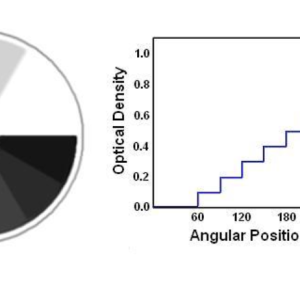
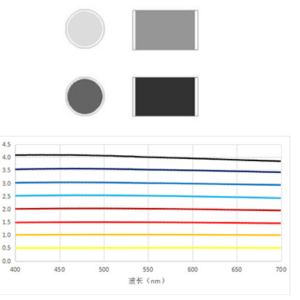
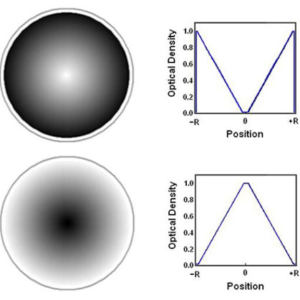
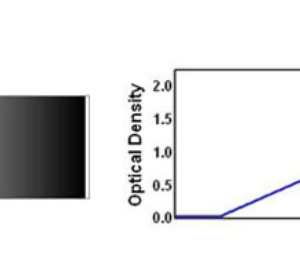
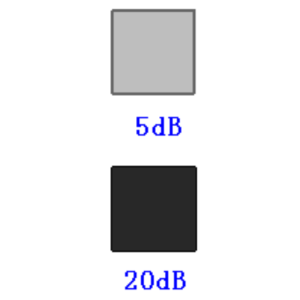
4. Neutral density ND attenuation filters
Used for multi-channel power balancing to avoid strong light saturation of PD detectors; Biochemical colorimetric and blood oxygen module calibration of light intensity
5. Cut off stray light filter (infrared cut/ultraviolet cut)
Blocking environmental sunlight and device infrared thermal radiation is a must-have for portable POCT machines
POCT mainstream wavelength matching models (most commonly used in fluorescence immunology)
1. Blue channel FAM (myocardial infarction, inflammation, infectious disease detection)
Excitation: BP470/15 (470nm center, 15nm bandwidth)
Launch: BP525/20/LWP500 Long Pass
2. Green channel FITC
Excitation: BP495/25
Launch: BP540/30
3. Red light Cy5/quantum dot (high-sensitivity micro detection)
Excitation: BP630/20
Launch: BP670/30
4. UV 365nm fluorescence (rapid nucleic acid POCT)
Excitation: BP365/20
Launch: BP610/20
5. Dry biochemical colorimetric POCT single wavelength
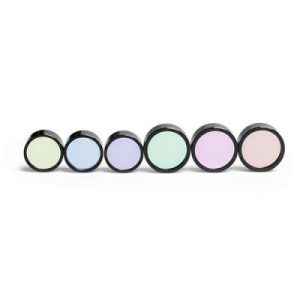
405, 450, 505, 546, 578, 600nm narrowband filters
6. Dedicated dual channel oximeter
BP660/10 (red light), BP940/10 (infrared)
There are some stock models available for selection above, if you need custom Optical POCT Filters or bulk orders, please contact our sales team:
info@borisuns.com
Related Products