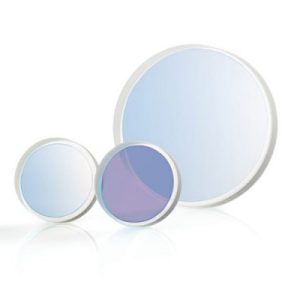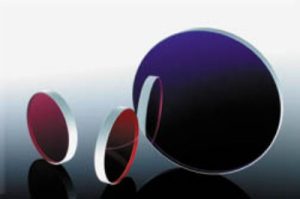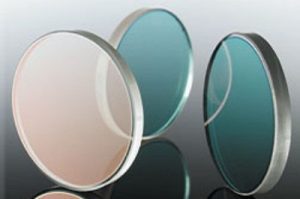
A filter is an optical device used to select the desired radiation band.
One commonality of filters is that no filter can make the imaging of celestial bodies brighter, because all filters absorb certain wavelengths, making objects darker.
The principle of a filter is made by adding special dyes to plastic or glass sheets. After vacuum coating or baking, the molecular structure changes and the refractive index also changes, resulting in changes in the passage of certain colored light.
The use of TiO2 and SiO2 thin film systems evaporated by electron beam (EB) for optical filters has important applications. However, with conventional evaporation techniques, even if the substrate temperature is above 300 ℃, the film still exhibits obvious columnar structural characteristics. This columnar structure of thin film contains a large number of voids in the film layer, so as the thin film filter absorbs moisture, the refractive index of the film layer increases,
The center wavelength of the filter will experience significant drift. To characterize this structural characteristic, people proposed the aggregation density P, which is defined as the ratio of the volume of the solid part in the film to the total volume. So it is a physical quantity that describes the degree of looseness of a thin film.
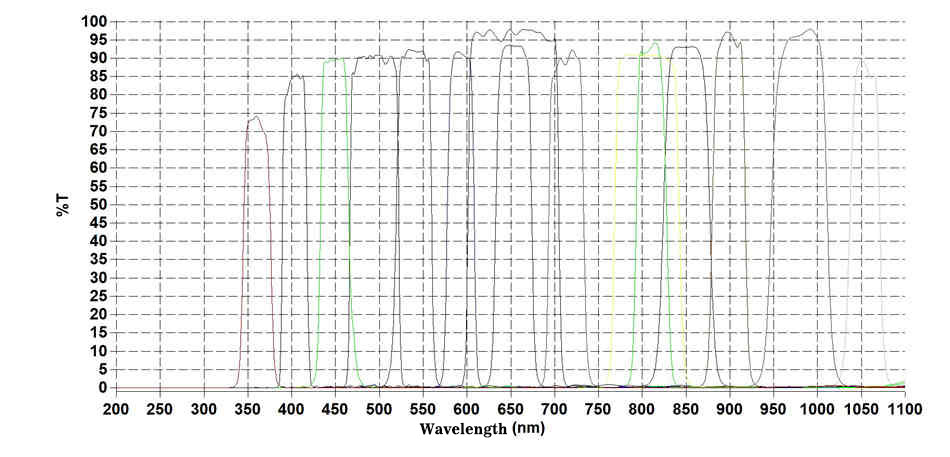
The filters produced by Hanzhong Borisun Optics Co.,Ltd can be divided into the following types:
Bandpass filter, narrowband filter, ultraviolet filter, neutral density filter (attenuator), dichroic mirror, beauty instrument filter, splitter, reflector, long wave pass filter, short wave pass filter, notch negative filter.